

Student Work Showcase
This page brings together student-created work developed through the postgraduate Food Safety Culture module. These presentations, toolkits, and short videos show how students translated key ideas from the module into practical outputs for real-world food business settings.
The showcase reflects learning in action: moving from understanding food safety culture as a concept to designing tools, explanations, and communication materials that help make safe behaviour more visible, meaningful, and achievable in everyday work.
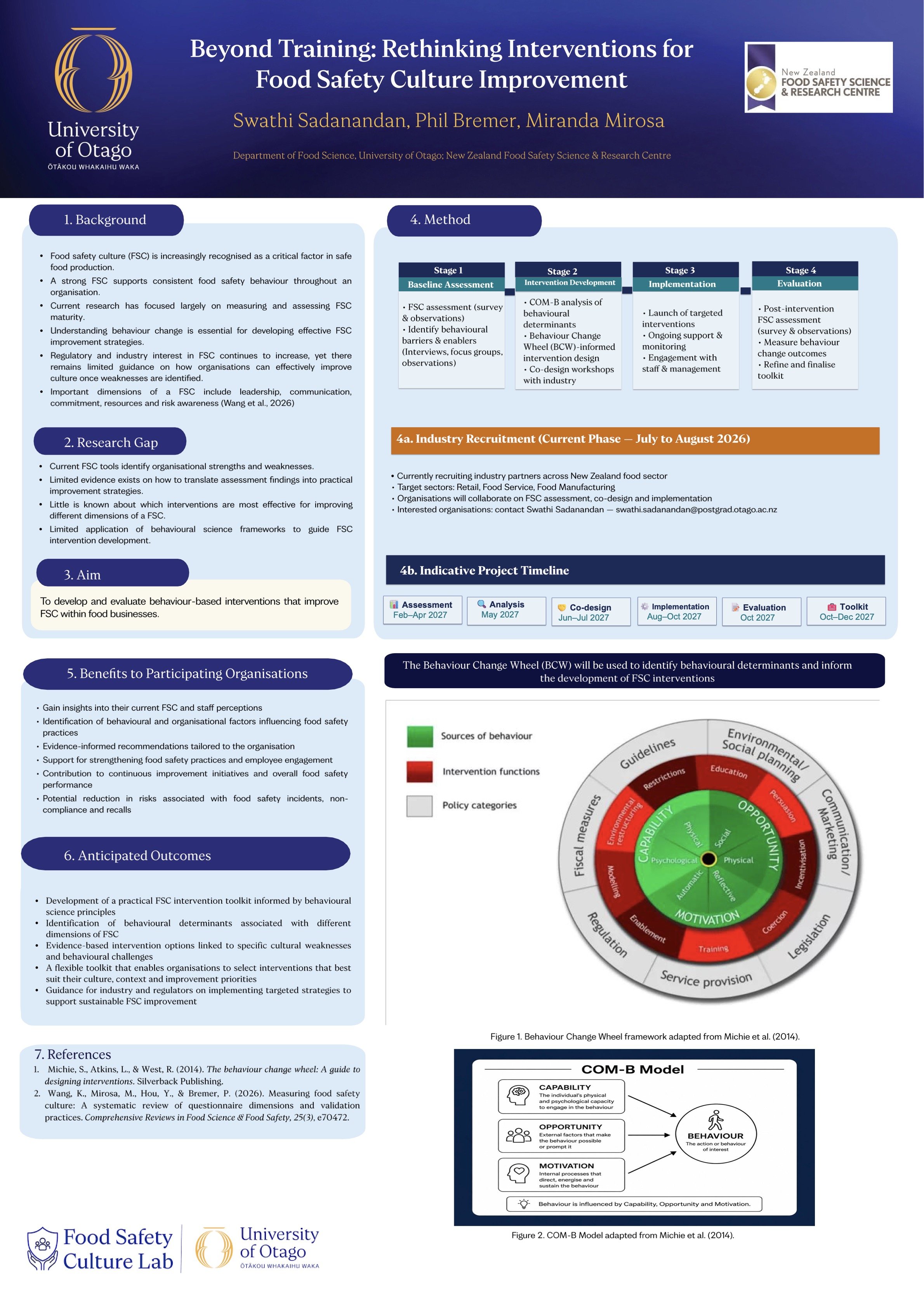
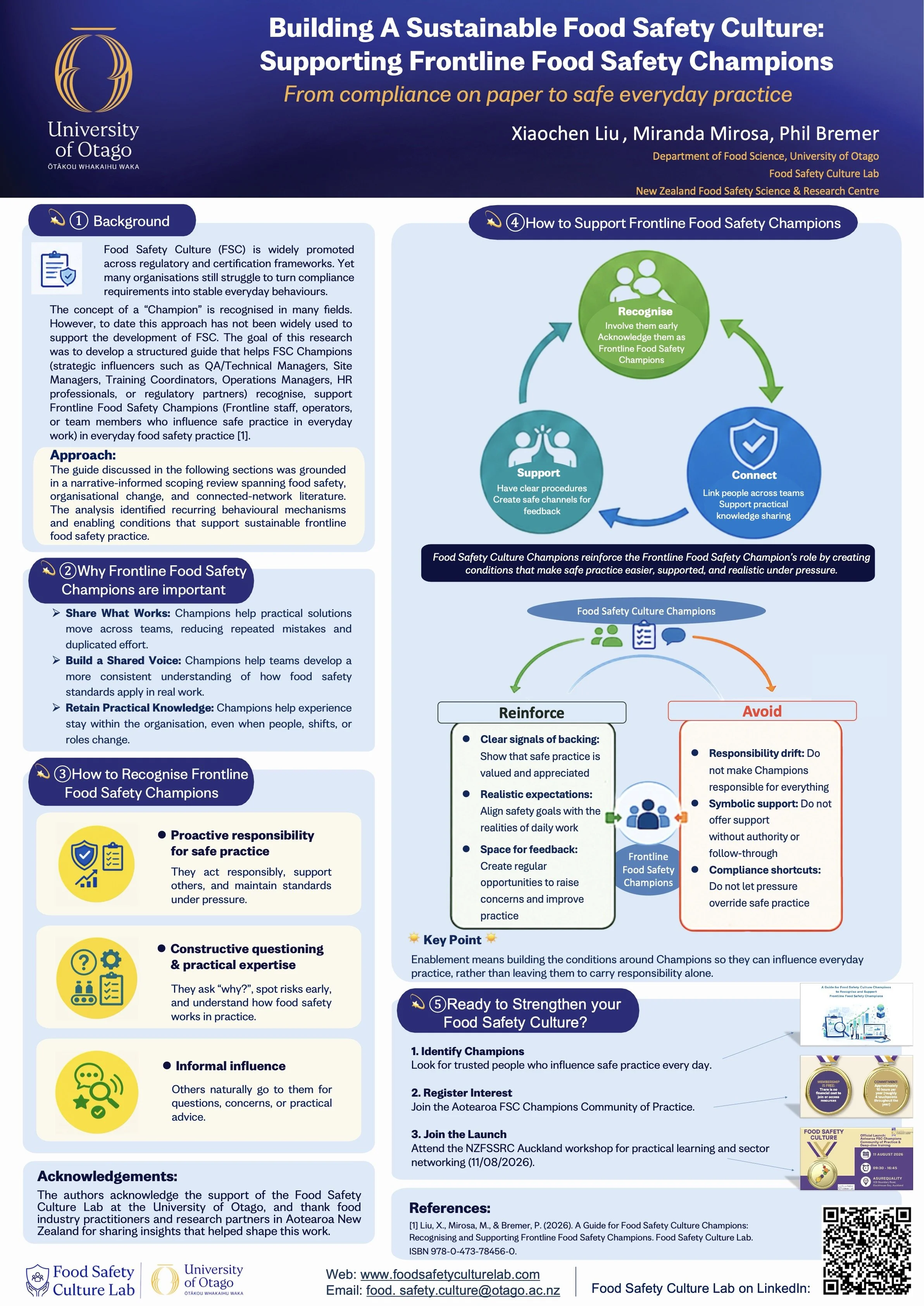
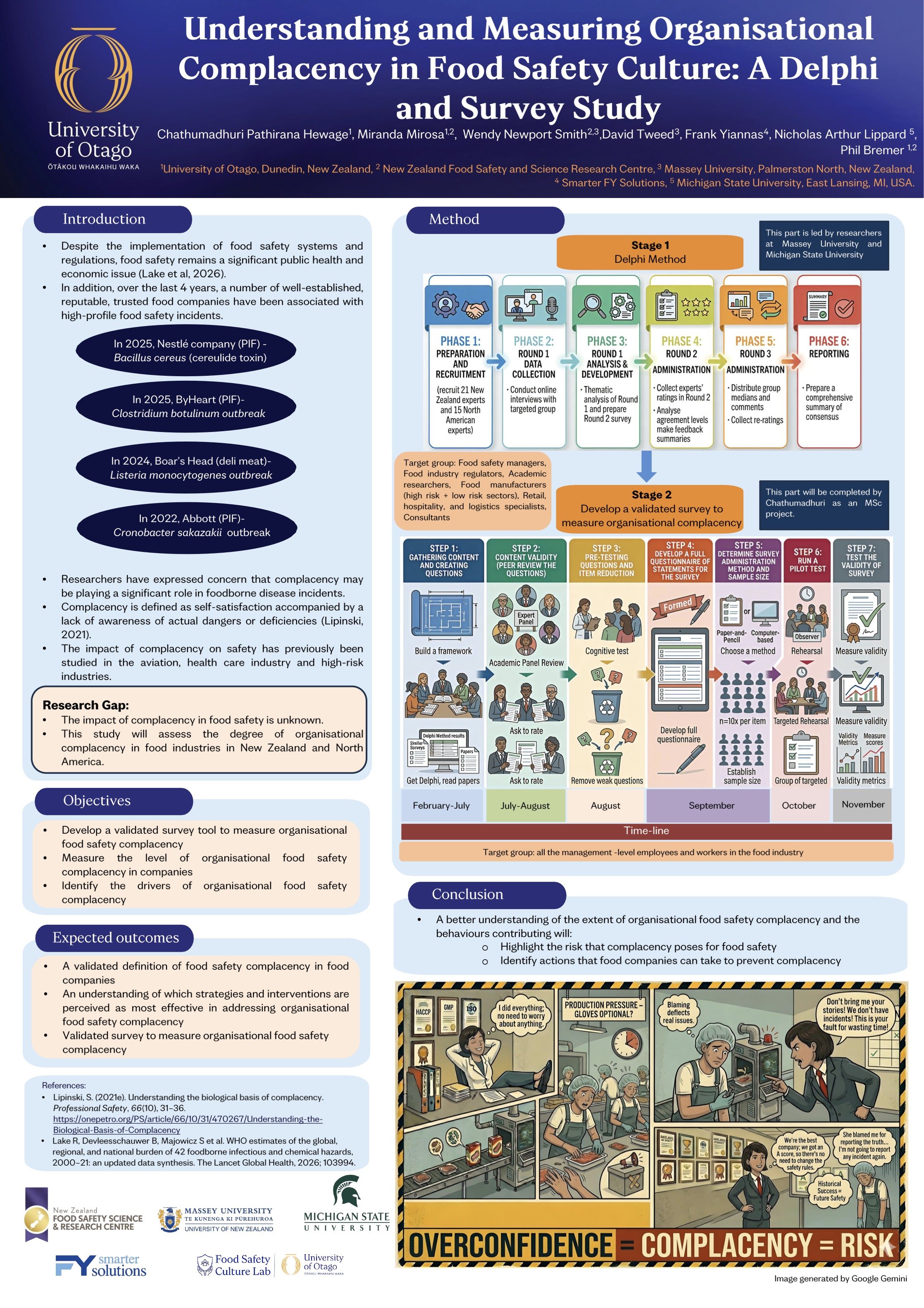
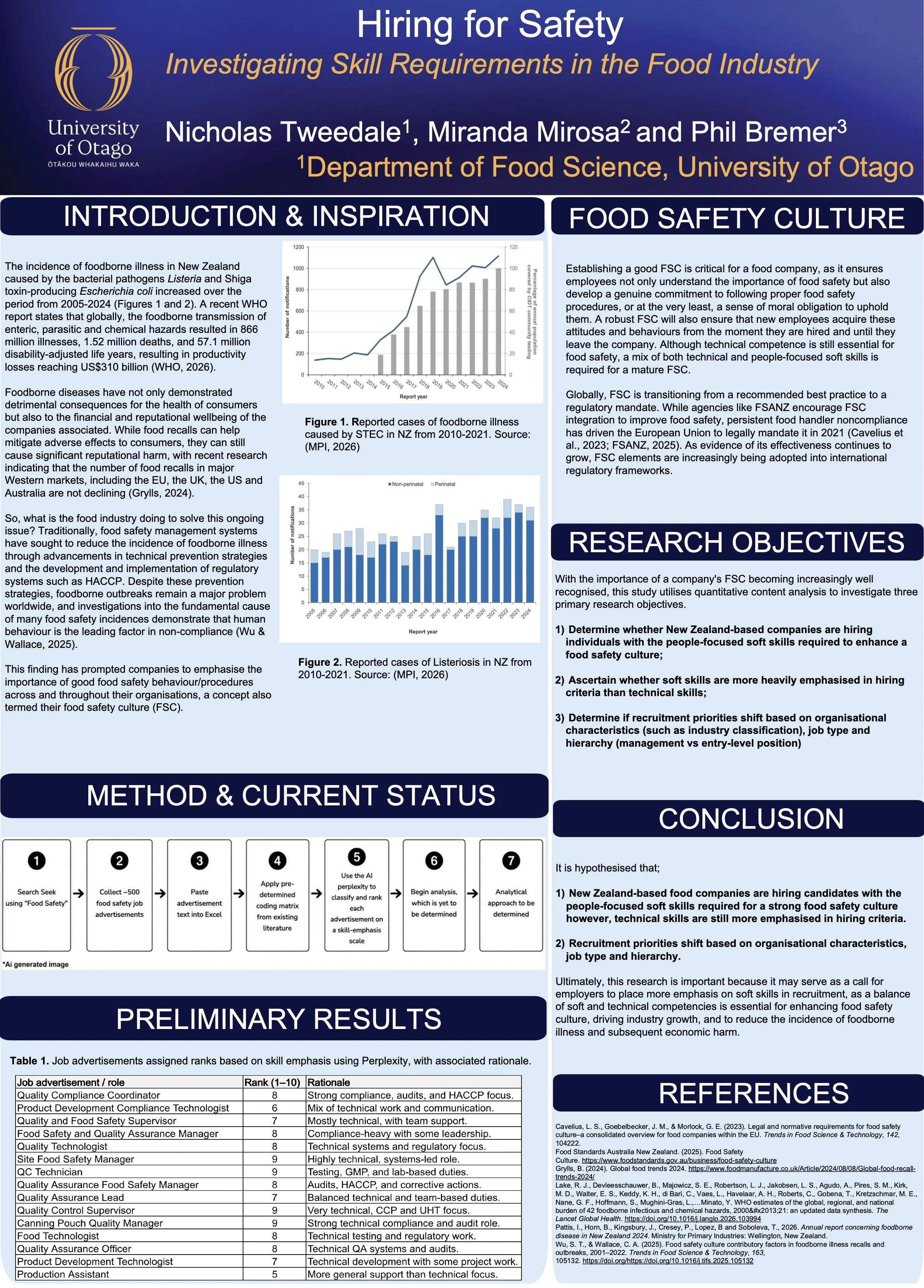
These four posters were presented at the NZIFST Conference 2026 in Auckland, bringing student research on training, frontline champions, organisational complacency, and hiring for food safety into conversation with the wider food science and industry community. Together, they reflect learning in action, translating evidence into practical questions, tools, and pathways for strengthening food safety culture.
Taking Student Research Beyond the Classroom
~· 2026 Cohort·~
Postgraduate Student Project Presentations
These presentations were developed as part of the postgraduate Food Safety Culture module, where students were asked to explore real-world food safety challenges and respond with practical, behaviourally informed solutions.
The task encouraged students to move beyond describing problems and instead design tools, systems, and interventions that could support safer practices in everyday settings, particularly in small and medium-sized food businesses.
Together, these projects reflect a range of approaches to translating food safety culture theory into practice. They show how students engage with complex ideas and begin to apply them in ways that are visible, structured, and relevant to real-world contexts, as further explored in our session reflection.
These videos were created as part of the Culture Hack assignment, where students were asked to explore psychological and behavioural concepts that are often hidden in everyday food safety work.
The task encouraged students to move beyond abstract explanation and consider how ideas such as cognitive bias, social influence, decision pressure, and habit formation might be communicated through short, accessible videos.
Together, these works show different attempts to translate food safety culture theory into public-facing communication. They reflect a learning process: experimenting with how complex ideas can be made more visible, relatable, and useful for real-world audiences.
Student Video Showcase: Making the Invisible Visible
-
Optimism bias occurs when a worker finds themselves in a safety breach predicament, and they calculate a cost (time and energy) to benefit (speed and efficiency) analysis towards following protocol that upholds health and safety standards. Known protocols are often ignored as workers tend to adopt an "it's not going to happen to me" attitude. To combat this mindset, those in leadership roles must be able to send a clear message to their workers that health risks imposed by non-immediate or invisible dangers are very real. They must also recalibrate the internal math that workers do when faced with these issues by establishing that working safely is, in fact, the most efficient way of working, reducing the risk of workers ignoring protocol for the sake of time and efficiency.
-
This video focuses mainly on the Health Belief Model (HBM), especially the idea of an “inner math” failure, where a worker makes a decision based on how the risk feels to them in the moment rather than the objective food safety risk. HBM is described as the “inner math based on subjective perceptions of reality,” which is tightly matched to a video scenario. Harry already knows the correct cleaning procedure, so the issue is not a lack of training. The problem is that, in that moment, he sees the safe action as too hard and inconvenient. He has class at 10am, the cleaning process takes a long time, and the sink is a bit far from the machine for him to wipe machine two times with water. These all increase his perceived barriers. At the same time, he tells himself that the chemical residue is probably only a small amount, so it is unlikely to harm anyone. That reflects low perceived susceptibility and also a kind of optimism bias.
The ABC model was also used in this video to make it clear that this is a system issue, not just a personal mistake. The antecedents are the staff shortage, the class-time clash, and the poor layout of the workstation. The behaviour is that Harry skips one wiping step. The immediate consequence is that he saves time and can get to class on time. This aligns with the idea that consequences often drive behaviour more strongly than rules do.
My call-to-action is to stop blaming workers and start redesigning the environment. The video is meant to encourage managers to see shortcuts as signs of friction in the system. By moving water spray and paper towels to the point of use, the safe choice becomes easier, faster, and more realistic under pressure.
-
The "Phone Contamination Trap," a behaviour motivated by System 1 thinking, which is quick, instinctive, and habitual decision-making, is highlighted in this video. Checking a phone while preparing food on a daily basis is a frequent and thoughtless action brought on by alerts. According to the ABC model, the phone alert is the antecedent, handling the phone and going back to meal preparation without washing hands is the behaviour, and convenience and little disruption are the outcomes or consequences because it saves time and effort, which encourages the risky behaviour.
The video takes a ‘Just Culture’ stance, acknowledging that the environment encourages this behaviour rather than portraying it as personal negligence. The Health Belief Model, in which the perceived severity is minimal since contamination is unseen, further increases the risk. Despite being a high-contact surface exposed to numerous sources of contamination, the phone seems harmless to an employee.
Solution for this would be by altering the surroundings, the intervention focuses on a behavioural "nudge." Salience is increased by designating a "phone zone" and providing a clear visual cue ("Phone = Wash Hands"), which makes the danger apparent at the time of action. Placing the “phone zone” area close to a sink also lowers the apparent barrier, making handwashing simple and quick. This guarantees that the solution relies on System 1 thinking instead of conscious effort or extra training. Instead of placing blame on specific people, the call to action is to create situations so that safe behaviour is the norm. By implementing simple, visible cues and locating the zone close in access to sanitary equipment, food safety practices can become automatic, even under routine or distracted conditions.
-
This video highlights how Optimism Bias and Cognitive Load combine to create predictable errors in high pressure food production environments. Optimism Bias is the mental shortcut that leads workers to believe that “nothing will go wrong this time”—especially when they’ve done a task hundreds of times before. In Jeni’s case, the label roll “looks right,” and her tired brain assumes the risk doesn’t apply to her.
At the end of a shift, fatigue pushes workers into System 1 thinking—fast, automatic, and intuitive. System 2, the slow, analytical mode required for accurate PEAL checks, becomes overloaded. This shift isn’t a personal flaw; it’s a neurocognitive response to exhaustion, time pressure, and repetitive tasks.
The video breaks down the ABC Model of the error:
Antecedents: similar looking rolls, end of day fatigue, and pressure to finish quickly
Behavior: grabbing the wrong roll and skipping the PEAL check
Consequence: saving ten seconds but creating a high risk allergen mislabelling event
The message is clear: this isn’t carelessness—it’s a system problem. When the environment relies on perfect memory, perfect attention, and perfect vigilance, errors are inevitable.
The Call to Action is to shift from blaming workers to designing better environments. The video promotes Nudge Theory and Choice Architecture as practical solutions, such as color-coded physical dividers (trays) and increased salience that interrupt autopilot and make the safe choice the default. These nudges reduce the Perceived Barrier by removing the “mental math” required to stay compliant when tired.
The intended behavioral impact is simple:
Don’t rely on people to be perfect. Build safety into the system, so PEAL compliance becomes automatic—even on the most exhausting days.
-
In the video, a student in food science laboratory is in hurry in handling meat for her experiment. Due to time pressure, she skips the step of changing the gloves used during meat handling and then touches the refrigerator door with same gloves.
She did this because she was running out of time and glove rack seems to be empty. If she must get new ones, they were in the next room. But her experience gave her a confidence to not take the new gloves. She takes the chance to use the same gloves as they looked clean with her eyes and touches the refrigerator door.
The student had done the same mistake in the past resulted in the belief of nothing happened before so it’s fine. But this time the contamination spreads and it also affects her experiment slowly. This resulted a false conclusion for her experiment with this minor unnoticed mistake.
The key idea in the video is about Optimism bias. Under any kind of pressure, they fail to follow food safety culture and choose to save time and effort.
The bacteria that have transferred from the meat to the gloves got spread over and a simple touch with the gloves can enhance the spreading of the bacteria all over the laboratory. This time the consequences of her action affected her work as well as contaminated the whole workplace. It is necessary to make sure everything is in position even before starting the work helps to reduce the optimism bias.
Moreover, they can also stick a poster labelling that to put the used gloves into the bin to avoid hazardous contaminations and to stock gloves, towels, and everything necessary in a laboratory prior to every work. This could change the behavioral aspects of the students.
-
This video has the theme of decision fatigue as an “invisible enemy” of food safety, using an analogy to a battery to make a complex psychological concept accessible to a general audience. The chosen audience for this video was industry training, so the tone is clear, practical, and informative. Emphasising that workers are ‘not careless, just tired’ highlights the importance of following established systems, reinforcing that food safety depends on reliable processes rather than individual effort alone as decision fatigue happens to everyone. The visuals and language used are intended to be simple (and relatable) so the message can get across to the intended audience.
Decision fatigue refers to the decline in decision quality after prolonged cognitive effort. In a food safety context, workers are required to make repeated, routine decisions (such as handwashing, temperature checks, and logging) which gradually deplete mental energy across a shift.
The battery metaphor given is a good comparison to use because it is universally understood (low battery = no energy etc) and is visually engaging/easy to understand. By showing the battery draining over time, the video illustrates why mistakes are more likely to occur at the end of a shift, not due to carelessness but due to general human psychological behaviour.
To address the problem, the video highlights the importance of following design systems like checklists, labelling, clear routines, and logging. Which is an important message to convey to industry workers.
Overall, the video combines engaging visuals, a relatable metaphor, and applied behavioural science to promote safer, more reliable food handling practices within a company.
-
‘This video explores a common behavioural failure in food science labs or related works: skipping glove changes between preparing different samples.
In the 1st scene, Paul is running out of time. The glove box is across the room. To save 10 seconds, he skips changing his gloves. He knows the safety rules, but under High Cognitive Load, his rational brain is simply overloaded. As a result, his System 1 (Autopilot) brain takes over, choosing the path of least resistance to get the job done.
To diagnose why this happens, I used the ABC Model. The Antecedent is the tight deadline combined with a poorly placed glove box. The Behaviour is skipping the glove change. The immediate Consequence is saving precious time.
Instead of just blaming the worker, I designed a solution using Nudge Theory. We don't need more training; we need a physical nudge. My "hack" moves the glove dispenser directly to Paul’s workstation (the point of use) and places it on a mat with text "Swap Zone". This creates Increased Salience, making the safe choice visually unmissable. It completely reduces the perceived barrier of having to walk across the lab.
Call-to-Action: This video is intended to influence food safety leaders to move away from a "blame culture" and start applying systems thinking. Rather than punishing staff for human error when they are tired or rushed, managers should hack the environment. We need to make the safest choice the absolute easiest choice for the "tired brain".
-
The presented culture hack video explores the psychological theory of optimism bias. Optimism bias is the tendency to underestimate the risks associated with an individual's actions and to overestimate the likelihood of a good outcome. This tendency is common when an individual has never experienced the negative consequences of their actions, leading them to believe they are the exception. This psychological phenomenon occurs when an individual’s System 2 (logical) brain is stressed or overloaded by external factors, prompting their System 1 (autopilot) brain to choose the most convenient action or the path of least resistance to relieve the stress they feel. This phenomenon is important to be aware of, especially when producing food, since improper food production can lead to major health issues for consumers. This culture hack video was created to raise awareness of optimism bias and show that extra training and better knowledge of food safety procedures are often not needed. Instead of extra training, the video shows that simple changes or rearrangements in any kitchen, whether that be in a restaurant or home, can reduce optimism bias. By “hacking the environment”, following proper food safety procedures becomes the path of least resistance, ensuring that food safety becomes automatic under any circumstance.
-
This video highlights how everyday food handling behaviours can lead to contamination, focusing on the practice of placing a used spoon on a countertop and reusing it. The key concept explored is automatic behaviour, as explained by Dual Process Theory. In fast-paced kitchen environments, workers rely on System 1 thinking, where actions are driven by habit and efficiency rather than conscious decision-making. As a result, placing a spoon on a nearby surface feels like a normal and acceptable action, even though it introduces a risk of contamination.
The video also applies the ABC Model (Antecedent- Behaviour- Consequence) to explain why this behaviour persists. The antecedent is the time pressure and workload in a busy kitchen, the behaviour is placing the spoon on the countertop, and the consequence is immediate convenience.
Because the behaviour saves time and does not result in an immediate negative outcome, it becomes reinforced and repeated as part of routine practice.
The purpose of the video is to shift perception from viewing this as an individual mistake to recognising it as a behaviour shaped by the environment. The call-to-action is to redesign the workflow by creating a clear and visible distinction between used and clean utensils. This intervention increases salience and reduces the effort required to choose the correct action.
By making the safer option more obvious and easier to follow, the video aims to influence
behaviour at a practical level. Rather than relying on memory or constant attention, it promotes a system where safe practices become the natural and consistent choice, even in high-pressure situations. In this way, food safety is embedded into the workflow, rather than dependent on individual judgement.
-
‘A’ for Antecedent in the ABC break down comes on the screen. The Antecedent is a booked-out restaurant that is getting more and more orders. More bookings won't stop coming in.
Scene 1: The problem
Visual: The problem is, it's a Saturday night, the restaurant is booked out, and the manager is rushing kitchen workers. A kitchen worker (Ella) is preparing chicken on a chopping board. She then disposes of the chicken and goes to wash the chopping board but sees the sink is full.
Internal audio: Ella is feeling rushed by her manager to get through these orders and doesn’t want to waste time washing dishes.
Scene 2: Behavioural analysis
Visual: Ella goes back to the chopping board and goes to cut a tomato but knows that she cannot cut it on a dirty chopping board. To save time she just cut the tomato while holding it and cut herself. ‘B’ for behaviour comes up on the screen. The behaviour is blood getting on the food, contaminating it. She didn’t notice and the red blood got on the red tomato without her noticing, sending it out to customers.
Narrator: Kitchen worker could be called lazy for not just washing the board but that won’t solve the issue of the customer being served contaminated food
Scene 3: The solution
Visual: ‘C’ for consequence comes up on the screen. The consequence is, a customer has been served blood just so the worker could save 30 seconds. A station with allocated chopping boards for meat, vegetables and dirty chopping boards
Narrator: Having an easily accessible station for kitchen workers leaves no excuse for taking short cuts.
Scene 4: The result
Visual: Ella puts her dirty chopping board in the dirty chopping board section and grabs a new clean vegetable chopping board and cuts her tomato safely before sending it out to customers.
Narrator: This design is for busy staff so everyone can work efficiently and hygienically without even having to think about contamination.
-
‘A’ for Antecedent in the ABC break down comes on the screen. The Antecedent is a booked-out restaurant that is getting more and more orders. More bookings won't stop coming in.
Scene 1: The problem
Visual: The problem is, it's a Saturday night, the restaurant is booked out, and the manager is rushing kitchen workers. A kitchen worker (Ella) is preparing chicken on a chopping board. She then disposes of the chicken and goes to wash the chopping board but sees the sink is full.
Internal audio: Ella is feeling rushed by her manager to get through these orders and doesn’t want to waste time washing dishes.
Scene 2: Behavioural analysis
Visual: Ella goes back to the chopping board and goes to cut a tomato but knows that she cannot cut it on a dirty chopping board. To save time she just cut the tomato while holding it and cut herself. ‘B’ for behaviour comes up on the screen. The behaviour is blood getting on the food, contaminating it. She didn’t notice and the red blood got on the red tomato without her noticing, sending it out to customers.
Narrator: Kitchen worker could be called lazy for not just washing the board but that won’t solve the issue of the customer being served contaminated food
Scene 3: The solution
Visual: ‘C’ for consequence comes up on the screen. The consequence is, a customer has been served blood just so the worker could save 30 seconds. A station with allocated chopping boards for meat, vegetables and dirty chopping boards
Narrator: Having an easily accessible station for kitchen workers leaves no excuse for taking short cuts.
Scene 4: The result
Visual: Ella puts her dirty chopping board in the dirty chopping board section and grabs a new clean vegetable chopping board and cuts her tomato safely before sending it out to customers.
Narrator: This design is for busy staff so everyone can work efficiently and hygienically without even having to think about contamination.
-
This video explores a common behavioural failure in food science labs or related works: skipping glove changes between preparing different samples.
In the 1st scene, Paul is running out of time. The glove box is across the room. To save 10 seconds, he skips changing his gloves. He knows the safety rules, but under High Cognitive Load, his rational brain is simply overloaded. As a result, his System 1 (Autopilot) brain takes over, choosing the path of least resistance to get the job done.
To diagnose why this happens, I used the ABC Model. The Antecedent is the tight deadline combined with a poorly placed glove box. The Behaviour is skipping the glove change. The immediate Consequence is saving precious time.
Instead of just blaming the worker, I designed a solution using Nudge Theory. We don't need more training; we need a physical nudge. My "hack" moves the glove dispenser directly to Paul’s workstation (the point of use) and places it on a mat with text "Swap Zone". This creates Increased Salience, making the safe choice visually unmissable. It completely reduces the perceived barrier of having to walk across the lab.
Call-to-Action: This video is intended to influence food safety leaders to move away from a "blame culture" and start applying systems thinking. Rather than punishing staff for human error when they are tired or rushed, managers should hack the environment. We need to make the safest choice the absolute easiest choice for the "tired brain".
-
This video is a fictional story based on a true case, depicting a chef, Mr. Zhang, experiencing a safety issue due to time pressure. The main theories are optimism bias and the brain's pattern switching under high pressure. My goal is to ensure food safety by utilizing simple spatial isolation to allow employees to safely complete tasks without relying on logical thinking.