

Sponsor a Summer Research Student
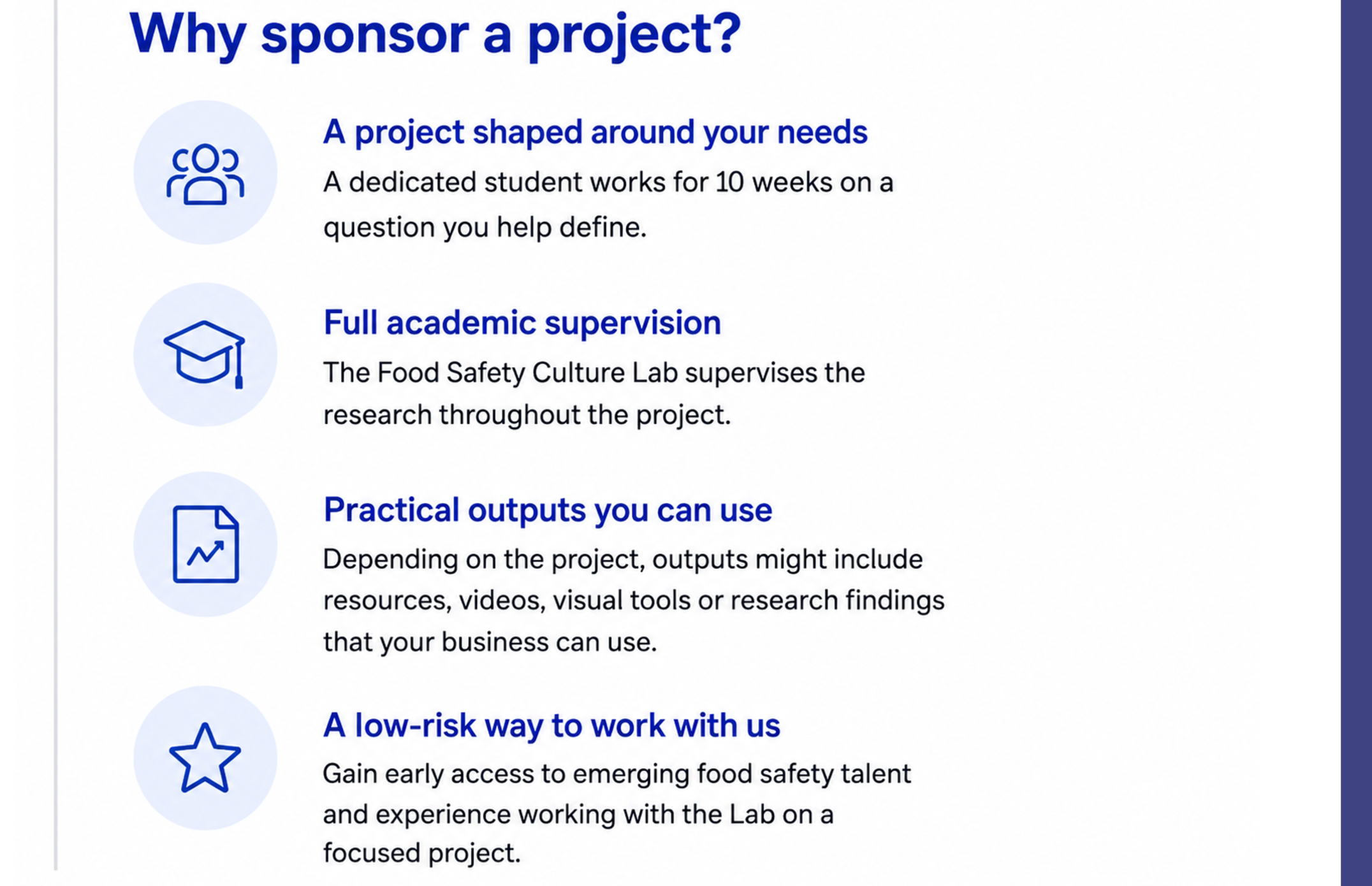
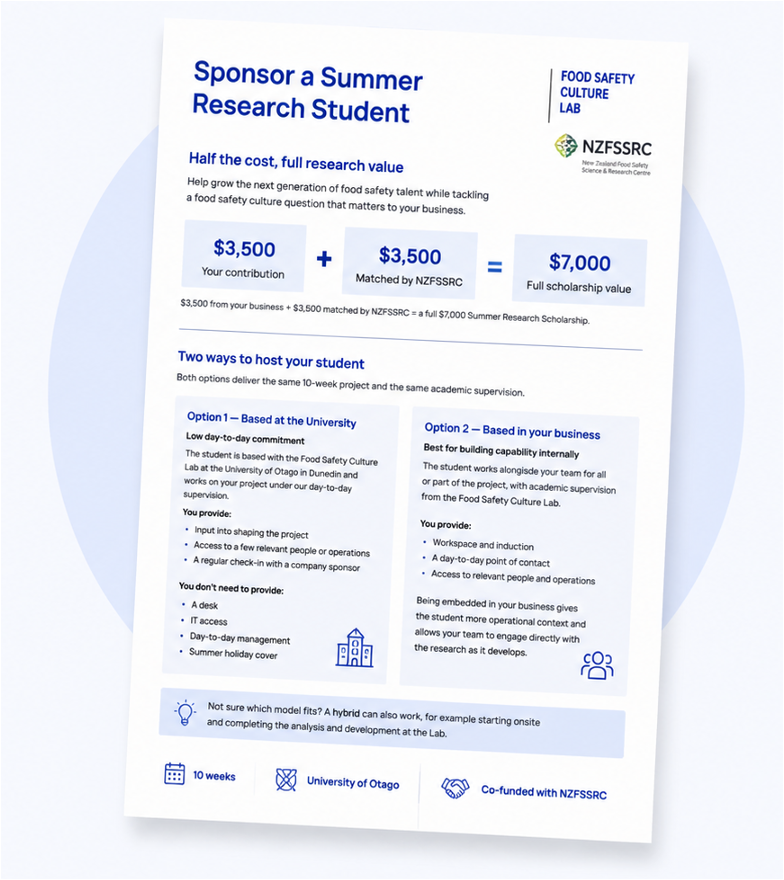
Half the cost, full research value
Help grow the next generation of food safety talent while tackling a food safety culture question that matters to your business.

Your $3,500 contribution is matched dollar-for-dollar by NZFSSRC, making up the full $7,000 scholarship value. No further contribution is required.
📅 Register by 30 September
10 weeks, full-time | University of Otago | Co-funded with NZFSSRC
Scheduled flexibly between early November and the end of February, with exact dates set to suit your business and the student's availability.
Two ways to host your student
Both options deliver the same 10-week project and the same academic supervision.
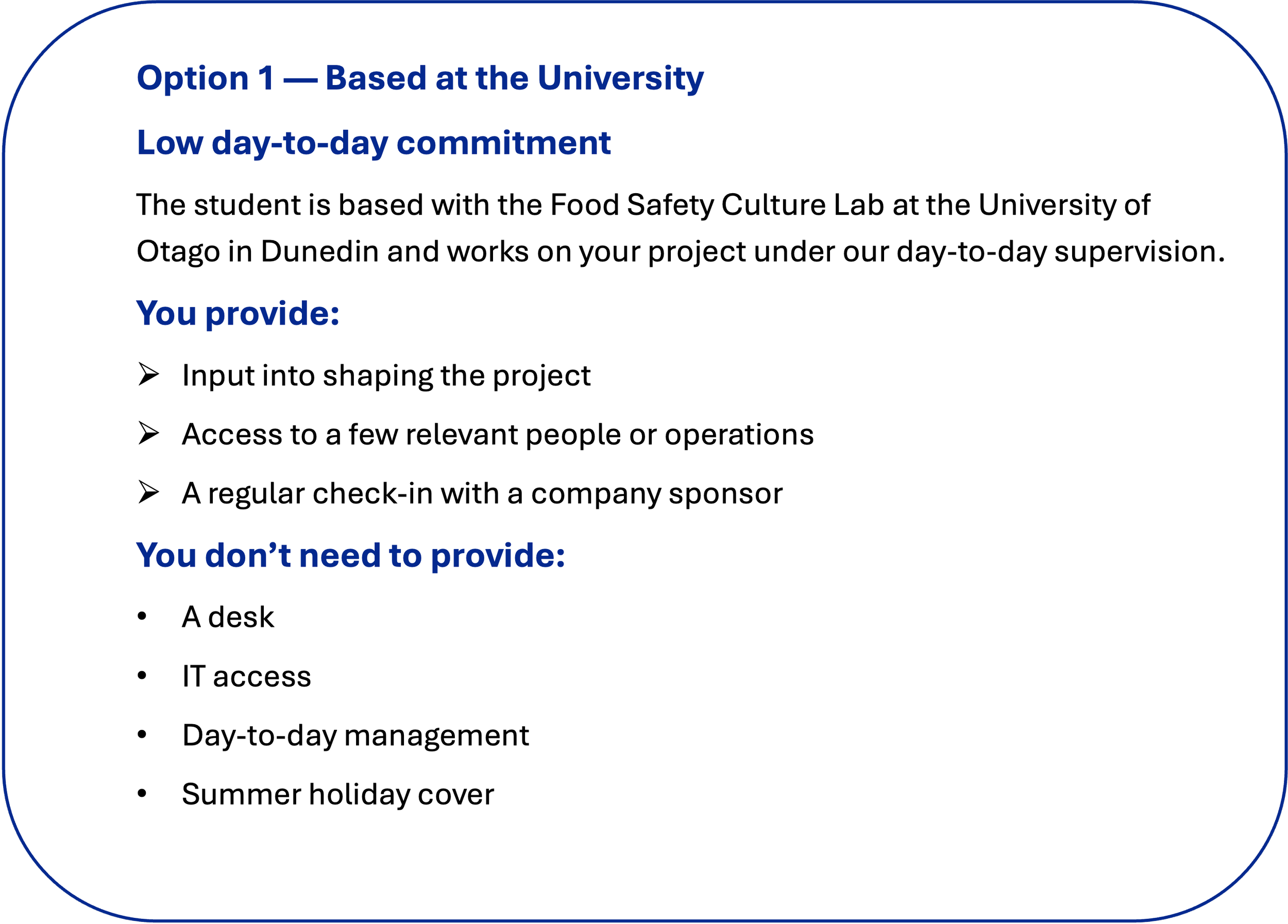
Why option 1: Designed for a low-demand summer
Project shaping usually takes one initial conversation. Relevant staff might contribute through a short interview or site walk-through, with a company sponsor joining a regular check-in, for example a 20–30 minute call every fortnight.
No induction is required from your business. This option is designed specifically for periods when teams are running thin over summer or key staff are on leave.
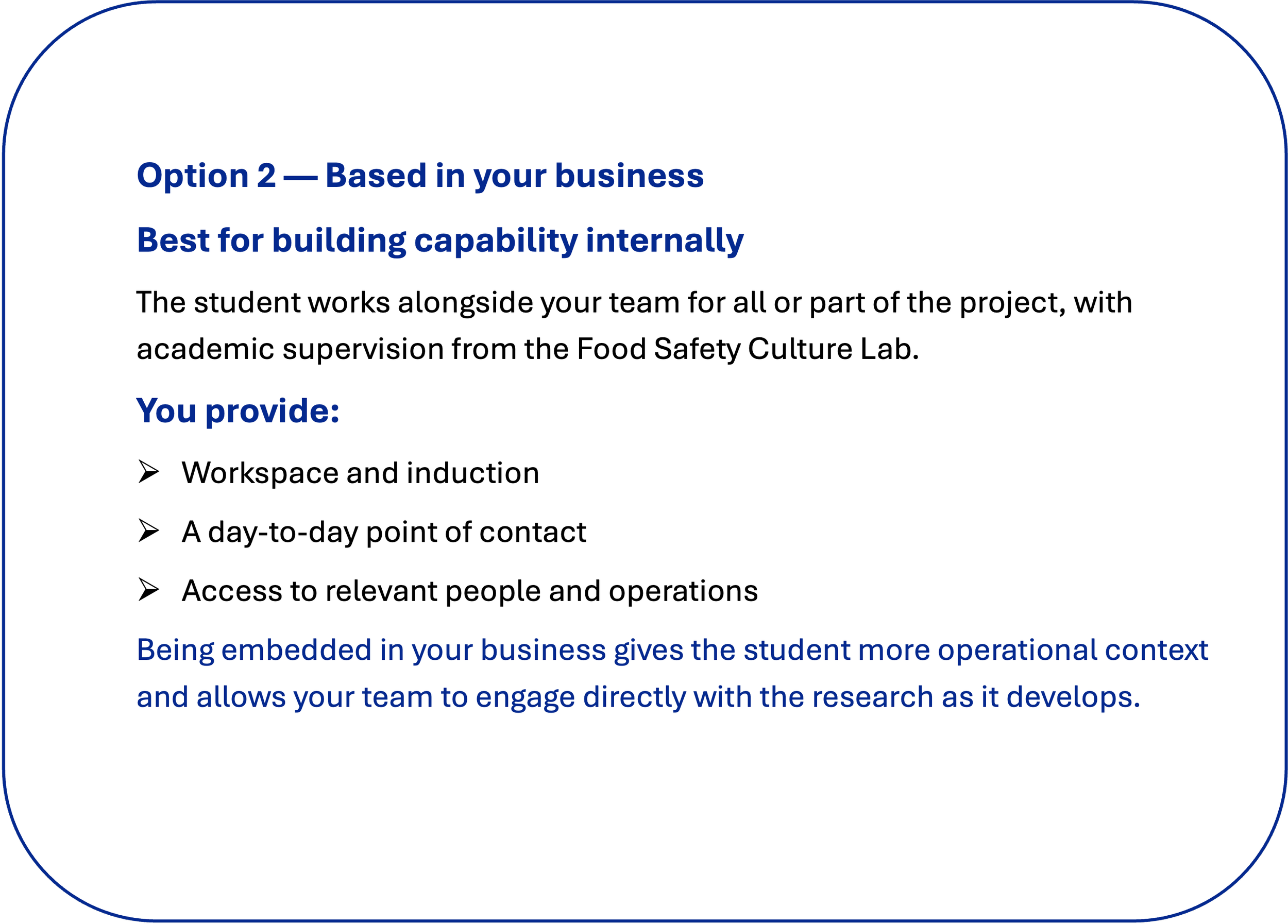
Why option 2: Closer to your operation
The Lab team supervises remotely and checks in regularly. Your business is involved in the same project-shaping process as Option 1, while giving the student direct access to the people and operational context needed for the work.
Where practical, this model leaves more capability within your business when the project ends.
Not sure which model fits?
Many companies start with Option 1 as a low-risk first project, then move to onsite hosting in later years once they have seen how the work operates.
A hybrid can also work well: for example, the student might spend a week or two onsite at the start to understand the context, then return to the Lab for analysis and development.
Talk to us and we’ll help you decide.
What could a project look like?
Projects are practical, scoped to 10 weeks, and grounded in behaviour change theory and ‘culture hacking’ — small, evidence-informed tweaks to how staff notice and act on food safety information.

Turn dense SOPs into clearer posters, infographics or quick-reference tools.

Develop short learning resources around topics such as allergens, temperature control or cleaning.

Explore more visual inductions, knowledge checks or clearer critical-control-point communication.

Turn real, anonymised near-misses and good catches into short, memorable posters or videos to make food safety messages more memorable.

Turn repetitive food safety tasks into streaks, team leaderboards or small visible rewards to help routine compliance stick.
Prefer the one-page overview?
A quick summary of the funding, project model and hosting options.
Frequently Asked Questions
-
You receive the student's findings and outputs at the end of the project and can use them in your business. We'll agree in advance how any information you share is anonymised, and what, if anything, can be used for academic purposes.
-
Yes. Confidentiality arrangements are put in place before the project starts, and anything published or presented is anonymised unless you agree otherwise.
-
The Food Safety Culture Lab team at the University of Otago, Professor Miranda Mirosa and Professor Phil Bremer, alongside the wider Lab. Academic supervision applies to both hosting options.
-
No. The student holds a University scholarship, not employment with your company.
-
Students apply through the University's Summer Research Scholarship process. We match candidates to projects and are happy to involve you in the selection.
-
Supervision is our responsibility. If a project needs re-scoping mid-way, the Lab team manages that with you.
-
Email food.safety.culture@otago.ac.nz with a line or two about your business and any question you'd like explored. We'll set up a short conversation to shape a project brief, with no commitment at that stage.